| Special Formulations |
| Formulations of wood preservatives are now available that include a water-repellent component, and even color additives. Marketed under a variety of brand names, these treatments provide convenience as well as optimum long-term appearance for outdoor projects. Consult your local lumber dealer about the availability and finishing recommendations of these special treatments in your area. |
Although treated wood is protected against decay and termite attack, the application of a water-repellent sealer to all exposed wood surfaces is recommended upon completion of construction. This sealer will help control surface checking (splitting or cracking) and provide an attractive appearance. Over time, reapplication of a sealer is recommended, perhaps every year or two; follow the manufacturer's instructions.
Over several months, pressure-treated Southern Pine lumber will weather naturally to an appealing silver-gray color.
Treated Southern Pine lumber will accept a finish similar to untreated material. Most importantly, Southern Pine should be dry before any type of finish is applied.
Following construction, most manufacturers of stains and paints recommend a waiting period - from a week to two months - before applying a finish to treated wood, if the project was built with lumber that was not kiln-dried after treatment (KDAT).
Most paint manufacturers recommend two coats of a good-quality acrylic latex paint for best results on treated Southern Pine. When applying any type of finish, be certain to follow the recommendations of the paint or stain manufacturer.
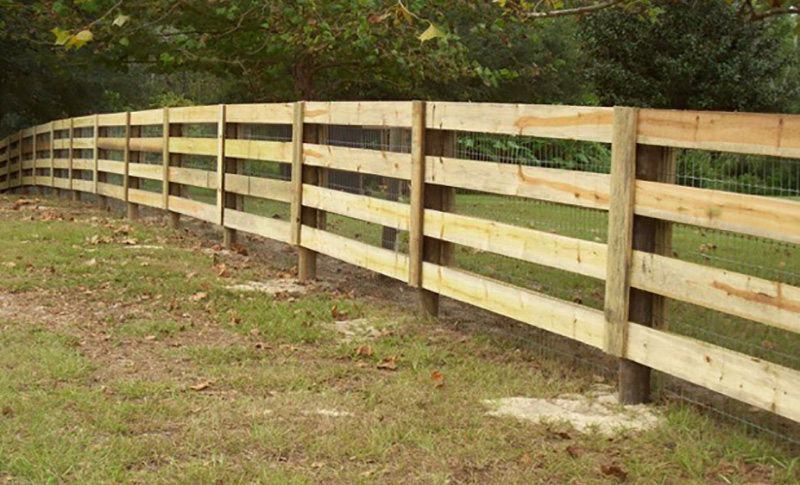
Fences
Decks & Porches
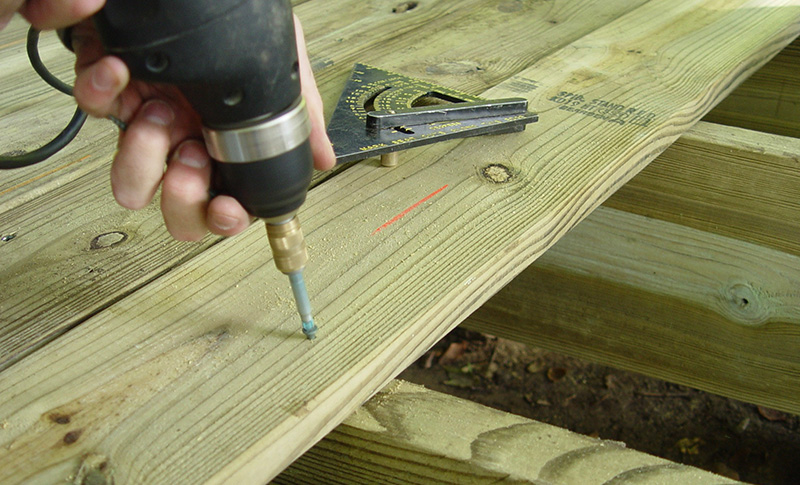
Decks and porches present a particularly severe exposure for both the wood and finishes. Most wood members are in a horizontal or flat position. These horizontal surfaces, especially in decks, are often exposed to the direct rays of the sun and tend to collect moisture, so the weathering process is greatly accelerated. As repeated cycles of wetting and drying occur, checks tend to enlarge rapidly into cracks and, along with the end-grain surfaces, begin to retain moisture. The conditions for decay and insect attack caused by the presence of moisture are thereby
greatly improved.
Any film-forming finish is likewise subjected to excessive stress because of the continuous shrinking and swelling of the wood that results from changes in its moisture content. Furthermore, the finish is subjected to abrasive wear, particularly in high-traffic areas. By design, porches are somewhat protected, so the conditions are not normally as severe as those with decks; however, the same conditions — moisture, sun, and abrasive wear — are usually present at
least periodically.
For fully exposed decks, a water-repellent sealer or a penetrating semi-transparent stain may provide the best finishing solution, even on wood that has been pressure treated with preservatives. Special formulations made specifically for decks are available. These penetrating deck finishes, at least the water-repellent sealers, may have a shorter service life than paint, but they are more easily renewed. For severe exposures, the finish should be renewed annually; spring is usually the best time. Light-colored penetrating stains will also last longer than dark ones on flat surfaces subjected to traffic, because light stains show the least contrast in grain color as wear occurs. The penetrating finishes need to be refinished every 1 to 2 years.
To refinish, a thorough cleaning of the wood with a stiff bristle brush is usually adequate before applying the water-repellent sealer or penetrating stain finish. Paint and solid-color stains, particularly in these applications, are likely to peel. Laborious scraping and sanding before refinishing will usually be required for these finishes. Therefore, paint and solid-color stains are not appropriate for fully exposed decks.
The bright color of the wood on weathered decks can be restored (and surface mold and mildew can be removed) by application of commercial products (labeled as deck cleaners, brighteners, or restorers). These products may remove the weathered wood surface; some care should be exercised not to remove excess wood. Color can also be restored using a liquid household bleach. The bleach is usually diluted with water (1 part bleach, 3 parts water) before it is applied to the deck. The bleach solution should be thoroughly rinsed from the deck with water. If the deck is to be finished after cleaning, allow 1 or 2 days drying time.
Paint may be used successfully on roof-protected porch floors. For optimum results, first treat the wood with a paintable water-repellent sealer/preservative. After the floor dries, a primer and two topcoats of porch and deck enamel should be applied. Porch enamel is especially formulated to resist abrasion and wear. Solid-color stains should never be used on flat surfaces such as decks and porches, because of their low resin content.

| Special Formulations |
| Formulations of wood preservatives are now available that include a water-repellent component, and even color additives. Marketed under a variety of brand names, these treatments provide convenience as well as optimum long-term appearance for outdoor projects. Consult your local lumber dealer about the availability and finishing recommendations of these special treatments in your area. |
Although treated wood is protected against decay and termite attack, the application of a water-repellent sealer to all exposed wood surfaces is recommended upon completion of construction. This sealer will help control surface checking (splitting or cracking) and provide an attractive appearance. Over time, reapplication of a sealer is recommended, perhaps every year or two; follow the manufacturer's instructions.
Over several months, pressure-treated Southern Pine lumber will weather naturally to an appealing silver-gray color.
Treated Southern Pine lumber will accept a finish similar to untreated material. Most importantly, Southern Pine should be dry before any type of finish is applied.
Following construction, most manufacturers of stains and paints recommend a waiting period - from a week to two months - before applying a finish to treated wood, if the project was built with lumber that was not kiln-dried after treatment (KDAT).
Most paint manufacturers recommend two coats of a good-quality acrylic latex paint for best results on treated Southern Pine. When applying any type of finish, be certain to follow the recommendations of the paint or stain manufacturer.
Fences
Decks & Porches
Decks and porches present a particularly severe exposure for both the wood and finishes. Most wood members are in a horizontal or flat position. These horizontal surfaces, especially in decks, are often exposed to the direct rays of the sun and tend to collect moisture, so the weathering process is greatly accelerated. As repeated cycles of wetting and drying occur, checks tend to enlarge rapidly into cracks and, along with the end-grain surfaces, begin to retain moisture. The conditions for decay and insect attack caused by the presence of moisture are thereby
greatly improved.
Any film-forming finish is likewise subjected to excessive stress because of the continuous shrinking and swelling of the wood that results from changes in its moisture content. Furthermore, the finish is subjected to abrasive wear, particularly in high-traffic areas. By design, porches are somewhat protected, so the conditions are not normally as severe as those with decks; however, the same conditions — moisture, sun, and abrasive wear — are usually present at
least periodically.
For fully exposed decks, a water-repellent sealer or a penetrating semi-transparent stain may provide the best finishing solution, even on wood that has been pressure treated with preservatives. Special formulations made specifically for decks are available. These penetrating deck finishes, at least the water-repellent sealers, may have a shorter service life than paint, but they are more easily renewed. For severe exposures, the finish should be renewed annually; spring is usually the best time. Light-colored penetrating stains will also last longer than dark ones on flat surfaces subjected to traffic, because light stains show the least contrast in grain color as wear occurs. The penetrating finishes need to be refinished every 1 to 2 years.
To refinish, a thorough cleaning of the wood with a stiff bristle brush is usually adequate before applying the water-repellent sealer or penetrating stain finish. Paint and solid-color stains, particularly in these applications, are likely to peel. Laborious scraping and sanding before refinishing will usually be required for these finishes. Therefore, paint and solid-color stains are not appropriate for fully exposed decks.
The bright color of the wood on weathered decks can be restored (and surface mold and mildew can be removed) by application of commercial products (labeled as deck cleaners, brighteners, or restorers). These products may remove the weathered wood surface; some care should be exercised not to remove excess wood. Color can also be restored using a liquid household bleach. The bleach is usually diluted with water (1 part bleach, 3 parts water) before it is applied to the deck. The bleach solution should be thoroughly rinsed from the deck with water. If the deck is to be finished after cleaning, allow 1 or 2 days drying time.
Paint may be used successfully on roof-protected porch floors. For optimum results, first treat the wood with a paintable water-repellent sealer/preservative. After the floor dries, a primer and two topcoats of porch and deck enamel should be applied. Porch enamel is especially formulated to resist abrasion and wear. Solid-color stains should never be used on flat surfaces such as decks and porches, because of their low resin content.