About SPC | Site Map | E-News Sign-up Search:  
Southern Pine by Design logo
Southern Pine Home


  Guide to Porch Flooring & Construction
More Info
  • Download PDF version of Guide to
    Southern Pine Porch Flooring
    .
  • Order Porch Construction Video.
  • To find a dealer, distributor or
    producer, go to the Product
    Locator
    .
  • Turn your cold, damp concrete porch into a comfortable, charming environment with pressure-treated Southern Pine.
  • The porch has withstood the test of time as an icon of American architecture, adding comfort, distinction and value. Today's home designs incorporate the porch as a natural extension of the family's living space.

    Southern Pine flooring has enjoyed a long history in porch construction. As with indoor flooring material, the effect of moisture in contact with wood is a top concern when designing and building a porch.

    Southern Pine, combined with the technology of wood preservation, is a superior porch flooring choice. With its built-in resistance to decay and termites, pressure-treated Southern Pine porch flooring, properly installed, will provide decades of satisfying service.

    This section provides information related to material specification, handling and storage, installation, finishing, and general construction considerations for porch floors using preservatively treated Porch Flooring Southern Pine.

    Sizes, Grades and Patterns

    The size, grade and pattern of flooring utilized in porches will depend upon the type of protection given to the structure. Porches without complete roof protection are generally constructed in the same manner as outdoor decks, incorporating a surface of either 2"x6" nominal size or 5/4x6 radius-edge pressure-treated Southern Pine. A dimension (2x) lumber grade of No.1 provides optimum appearance. Radius-edge decking is available in Premium or Standard grades.

    The recommendations outlined in this section refer to flooring for fully-covered porches. Porch flooring is similar in sizes, grades, and patterns as the interior flooring described earlier in this booklet.

    Typically, nominal thicknesses are 1" and 1-1/4" (3/4" and 1" actual) with the tongue-and-groove pattern, available in widths of 4" to 6" nominal (3-1/8" to 5-1/8" actual). The grade of C&Better is most-often specified for porch flooring applications. Refer to Table 1 under grades for complete descriptions of flooring grades.

    Preservative Treatment Recommended

    To combat the deteriorating effects of outdoor exposure, moisture, decay and termite attack, pressure treatment with a waterborne preservative is recommended for all wood components of the porch. These preservatives are odorless and paintable, offering superior protection to Southern Pine products in severe outdoor exposure conditions.

    Standards developed by the American Wood Protection Association (AWPA) govern the use and specification of all wood preservatives used in pressure-treating processes. Most building codes require that wood in close proximity to the ground be pressure-treated to specific preservative retention levels, according to AWPA Standards. This requirement applies to flooring and floor joists within 18" of exposed soil and structural materials such as columns, posts, girders and beams, within 12" of exposed soil. Pressure-treated Southern Pine lumber is treated to retention levels appropriate to its exposure condition, either for installation above ground or in ground contact. A label (typically an end-tag) or an ink stamp placed on the lumber will denote whether the lumber is treated for either above ground use or ground contact.

    Generally, above-ground retention is adequate for porch flooring, floor joists and other components used above ground, while a higher preservative retention for ground contact is necessary for wood in direct contact with the soil, such as posts.

    For complete details about products, standards and applications, consult the booklet Pressure-Treated Southern Pine, available from the Southern Pine Council.

    Moisture Content and Material Acclimation

    Prior to pressure treatment, a package of Southern Pine T&G porch flooring is at a moisture content of 12% for the majority of pieces if specified, represented, and grade marked as kiln-dried (KD). With a waterborne preservative, water is part of the pressure-treating process, greatly increasing the moisture content of the wood, often to a moisture content of 50% and higher. For porch flooring, the specification of material that is kiln-dried-after-treatment (KDAT) is highly recommended. Redrying the treated material will return each piece to a workable moisture content, generally to 19% or less. The advantages of KDAT flooring material include enhanced dimensional stability, plus reduced tendencies to warp, twist, and cup.

    Porch Flooring

    The same basic rules for the proper storage, handling, and shipping of interior flooring also apply here; see Storage and Acclimation. Remember, the pressure treatment of wood does not prevent the normal passage of moisture in and out of lumber. KDAT Southern Pine flooring will react the same as untreated interior flooring when exposed to moisture prior to installation and finishing.

    A period of acclimation should be given to both the porch framing components and the pressure-treated porch flooring. Upon completion of the porch framing, it is common for experienced builders to allow one to two weeks for the framing materials to reach an equilibrium moisture content (EMC) with the exterior conditions, prior to flooring installation. This practice will reduce potential problems of buckling or separation of the flooring if installed on the framing too soon.

    Proper acclimation of the flooring begins with its delivery to the job site. The material should be unloaded in a dry place and stacked on stringers to permit adequate air circulation. A layer of polyethylene should be positioned directly under all packages of flooring to prevent moisture absorption from the ground. If the temporary storage area is not fully protected from precipitation, the flooring must be loosely covered for protection from moisture (4-mil polyethylene is commonly used), yet allowing adequate circulation of air within the package. If at all possible, do not store the flooring in an area that receives direct sunlight most of the day, or in an enclosed, heated space. These conditions can allow the flooring to equalize at a moisture content too low for its intended use.

    Generally, one to two weeks is considered an adequate acclimation period for KDAT porch flooring. The average moisture content of wood materials used in exterior applications is 12% for most areas of the U.S.

    Porch Flooring Installation and Finishing
    Figure 14 Porch Flooring Details

    Reducing the opportunities for dimensional changes to the material due to moisture fluctuations is the key to long-term performance of the porch floor. Proper porch flooring installation actually involves applying the finish prior to installation.

    Many builders begin with a coat of a water-repellent sealer on the top of all floor joists, providing added protection against joist expansion due to excessive collection of moisture.

    For the porch flooring, begin with a coat of paintable water-repellent sealer to all four sides and the ends, followed by (after adequate drying time) a coat of high-quality, mildew-resistant oil-based primer for exterior use. Consider applying a coat of the final oil-based porch enamel to the tongue and grooves (also to the end of any piece that will be adjacent to the house) and installing it while the paint is still wet. This procedure not only assures an effective seal against moisture penetration, but also provides a good bond between floor boards.

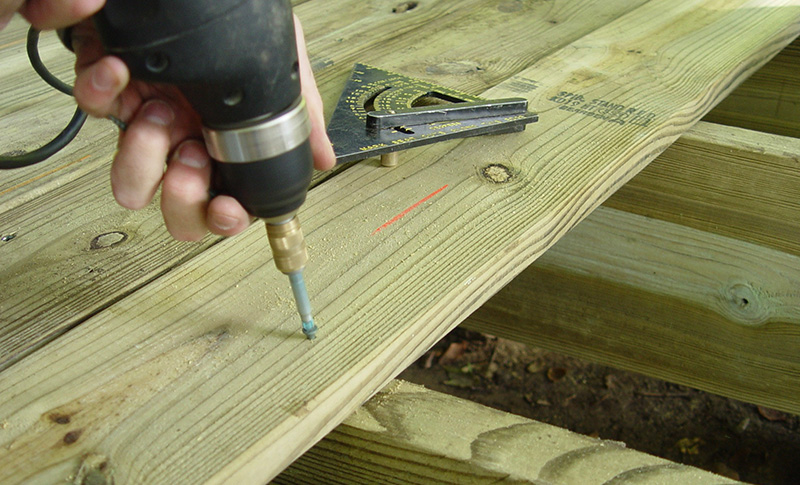
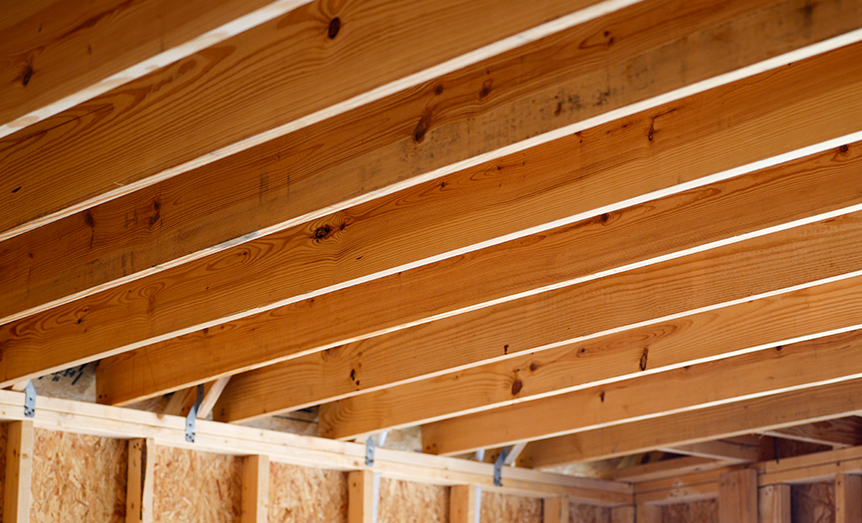
    Maximum recommended joist spacing for installing Southern Pine porch flooring is 16" on center. For a more solid feel, 12" on center is an option. Unlike interior flooring, T&G porch flooring is fastened directly to the floor joists. No additional nailing base is needed. Each piece of flooring is blind-nailed at every joist, using hot-dip galvanized 8d ring-shank nails (see Fasteners & Connectors for Pressure-Treated Lumber). A minimum 1/2" expansion space is maintained between the flooring area and house (or wall) to allow for dimensional change. This space can be concealed with decorative exterior trim (also acclimated). Extend flooring beyond the porch front band joist to allow a 1" overhang.

    Upon completion of the flooring installation, two coats of the oil-based porch enamel to the surface and exposed ends is recommended. Solid-color stains should never be used on a porch floor due to their low resin content.

    To maintain the optimum performance of a porch following proper design, material specification, installation and finishing, a regular maintenance program should be undertaken. Inspection for water accumulation, integrity of the soil barrier, and any raised fasteners are just a few items to include in a periodic examination of the structure. Take necessary corrective action as soon as possible. Refinishing porch flooring can be expected every 3 to 5 years, depending upon weather conditions and the amount of exposure to direct sunlight.

    Porch Design Considerations

    Attention to proper porch design is as important to the longevity of the structure as are the details of porch flooring specification and installation. Inadequate air circulation beneath the porch and trapped moisture between framing components will greatly reduce the serviceability and long-term appearance of the porch.

    The following recommendations are key elements to the proper design and construction of a fully-covered porch:

  • Slope the exposed soil underneath the porch away from the center to permit runoff of any water that may accumulate.

  • To reduce the upward migration of moisture from the exposed soil beneath the porch, cover with a moisture barrier (4-mil polyethylene is acceptable), leaving two feet of exposed soil inside the perimeter of the porch. Anchor edges of this barrier with gravel.

  • Encourage air flow beneath the porch by using ornamental vents or lattice skirting.

  • Slope the porch framing 1/4" per foot away from the house to permit adequate water runoff.

  • Vent columns and newell posts at top and bottom.

  • Check with your local building code department to be sure all code requirements are satisfied within your porch design.


  • Southern Pine Council™
    Copyright © 1995-2009. All rights reserved.
    Legal Disclaimer