Here are answers to some of the more frequently asked questions about Southern Pine. If you
don't find an answer to your question on our site or in these FAQs, please contact our Wood
Products Help Desk.
Southern Pine interior flooring
Lumber sizes were reduced by 1/8 inch in width and thickness during the 1970s, so the dimensions of pattern stock, such as flooring, cut from this lumber have also been reduced proportionally by 1/8th. Today, standard patterns of Southern Pine strip flooring (strip is anything under 4'') are cut in widths of 1 1/8, 2 1/8 or 3 1/8 inches on the face (less the tongue and groove). As a result, it may take some detective work to get what you need. You may be able to find a mill capable of producing a custom run, but it will be costly. Furthermore, if the flooring is heart pine, you will probably need to find some antique heart pine flooring for a genuine match, or to at least match color, experiment with stains. You will also need to specify flat grain or vertical grain. You may be able to find some heart pine boards and have a local custom millwork shop run them to pattern. Try the product database at Traditional-Building.com for a start.
Another idea would be to replace all damaged boards in the visible living areas with good boards taken (carefully!) out of smaller rooms or closets (solves the color match and sizing problem), then install new flooring (stained to match) where the old was cannibalized. We recommend a professional installer anyway you go.
It is recommended that a protective sealer be applied to Southern Pine flooring. There are two types of sealers: penetrating sealers and surface sealers.
Penetrating sealers are floor waxes that prevent penetration of liquids and dirt into flooring. Do not use any floor wax product containing water. Read the wax label carefully to make certain it is suitable for wood floors.
Surface sealers are finishes that do not penetrate the wood-wearing surface, but create a wood-bonding surface layer. Types of surface sealers include polyurethanes, moisture cured urethanes and acid-cured urethanes. Polyurethanes are available in both oil and water-based formulations and offer excellent resistance to wear. Polyurethanes tend to yellow as they age, slightly tinting the floor finish. Moisture-cured urethanes are the hardest of the surface sealers and are extremely prone to finishing errors. Applying these under the supervision of an experienced floor-finishing professional is recommended. Acid-cured urethanes, also known as ''Swedish-finishes'' provide a clearer and somewhat harder surface than polyurethanes.
Due to the technical nature of the application of such finishes, we recommend consulting a floor-finishing expert. Refer to the guidance in A Guide to Southern Pine Flooring. Also see the National Wood Flooring Association website for more information.
Some separation or gapping is normal with wood floors. Wood is a hygroscopic material and will absorb or give up moisture with changes in climate. Gaps may appear in wood flooring during dry months and close during the wet season. Even larger gaps may appear in plank flooring due to a greater proportional shrinkage in the wider material. Gaps up to a dime's thickness are considered acceptable for strip flooring and two dimes is not considered unusual for plank flooring. Maintaining environmental equilibrium year-round is very important to long-term wood floor performance.
NOTE: Extra care is necessary for good performance of plank floors since wider widths will move more (shrink and swell) with changing conditions. Before installation, proper acclimation is critical, excess sources of moisture must be identified and eliminated, and vapor barriers must be installed to reduce moisture absorption during service. After acclimation and before installation, sealing the back surface may help prevent some cupping normally associated with wider widths. Another practice to consider is leaving a slight expansion crack, about the thickness of a putty knife (1/16th inch), between planks. See the guidance in A Guide to Southern Pine Flooring. Also see the National Wood Flooring Association website for more information.
Wood flooring measuring 4 inches and wider is considered plank. Extra care is necessary for good performance of plank floors since wider widths will move more (shrink and swell) with changing conditions. Due to the greater amount of wood per piece, plank flooring has a larger tendency to shrink or swell with a change in moisture content than does more narrow, strip flooring. Therefore, plank flooring has a greater tendency than more narrow, strip flooring to develop a cupped condition should job site moisture levels increase, or to develop gaps between planks and/or checks/splits should job site moisture levels decrease.
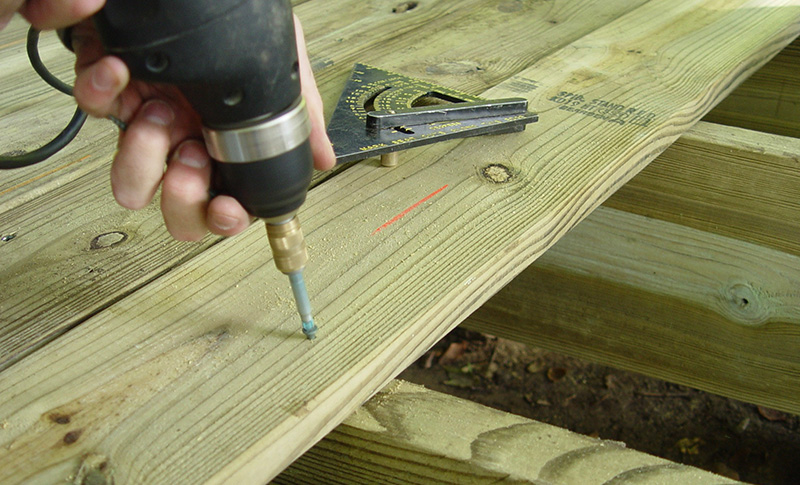
This larger tendency for planks to develop a cupped condition and/or gaps can be associated with unwanted up and down movement of planks in the flooring system. To prevent this up and down movement, experienced floor installers recommend that plank flooring be face-nailed as well as following a normal 8" spaced blind nail schedule over the tongue. We recommend face-nailing with an 8d (2 ½ inch) finish nail (pre-drill pilot holes to avoid splitting) or a 15-gauge finish nail gun.
For plank flooring 4 to 8 inches wide, install two face nails at each butt, spaced about 1½ inch from the butt end and edge. Along the course, one face nail in the center of the plank will work. Nail 16 inches on center over joists, or every 24 inches over a plywood sub floor. A carefully measured and placed string line or light pencil mark (not a chalk line) can be used to mark nail locations.
For plank 10 inches wide, use two nails per plank along the entire course, spacing nails about 1 ¾ inch from the butt and/or edge. For plank 12 inches and wider, we recommend three nails. Countersink nails 1/8 inch and fill before starting the finishing steps.
Before installation of plank or strip flooring, proper acclimation is critical, excess sources of moisture must be identified and eliminated and vapor barriers must be installed to reduce moisture absorption during service. After acclimation and before installation, sealing the back surface of plank flooring may help prevent some cupping normally associated with wider widths: sealing the underside of strip flooring is usually not required. With wider plank flooring, consider leaving a slight expansion crack about the thickness of a putty knife (1/16th inch) between planks.
See A Guide to Southern Pine Flooring and the National Wood Flooring Association
website for more information.
We do not recommend gluing down or floating solid-sawn, unidirectional, plank wood flooring. To "float" a floor, boards are glued together tongue to groove, but not attached to the sub floor. The only types of wood flooring that should be floated are engineered wood flooring products specifically manufactured for floating. The only solid wood flooring products that should be glued down over the entire installation are parquet, herringbone, and some engineered strip or plank wood flooring. Check with the flooring manufacturer before gluing down or floating any of these types of flooring.
Solid-sawn, unidirectional plank wood flooring should be mechanically fastened using flooring nails or staples. This type of flooring has certain characteristics that make gluing to any surface impractical. First and foremost, the normal shrinkage and swelling cycle that occurs with changes in moisture content (such as seasonal humidity) may weaken and eventually break any glue bond between the planks and sub floor in a glue-down installation or between planks in a floating floor installation. So long as the flooring is not exposed to excessive moisture conditions, mechanical fasteners allow some flexibility in the flooring system, while maintaining a proper attachment of the wood flooring to the sub floor.
Second, if the flooring is glued down over concrete, a proper vapor retarder cannot be installed between the concrete slab and the wood flooring. With solid-sawn strip or plank flooring, exposure to moisture from the concrete may lead to cupping and buckling of the boards. In addition to an unsightly appearance, the cupping and buckling will break the glue bond.
Third, the milling and finishing process itself may leave imperfections in some boards that may make surface-to-surface bonding a problem. The planks may have slight bends, sweeps or crooks that prevent the planks from being properly glued together as required with a floating installation or prevent the strips from properly adhering to the sub floor as with a glue-down installation.
Fourth, if one is able to install a site-finished, plank floor by using the floating floor method, there are concerns that the flooring will move after installation. Movement of the flooring may result in problems during the sanding and finishing process such as chatter marks.
The only time glue should be used to install solid-sawn, unidirectional plank flooring is when a single board replacement is being performed. In this case, the flooring contractor may choose to glue down the replacement plank, or to glue and face-nail the replacement plank.
Refer to the guidance in A Guide to Southern Pine Flooring. Also see the National Wood Flooring Association website for more information.
Environmental
No. Building with wood products actually helps the environment by mitigating climate change. Wood products have attributes that contribute to a healthy environment, such as the ability to store carbon while being formed naturally as trees and during their service life as building products. Scientists have reported that removing carbon from the atmosphere is one of the most significant ways to reduce the negative impacts of climate change. Also, wood products have been shown to require substantially less energy to manufacture, transport, construct and maintain than materials such as steel and concrete. So using wood products from sustainably managed forests ensures the growth of potential carbon storage through our forests and wood products.
For more information on the environmental benefits of building with wood products click the following links:
Wood and Green BuildingMiscellaneous
Our friends at Maze Nails explain that the ''d'' abbreviation for 'penny' is of ancient origin, representing the first letter of the Roman coin denarius.
There are two possible explanations for the English 'penny' system of designating nail lengths. One is that the eight-penny, six-penny, two-penny nails, etc. were so-called originally because 100 nails cost eightpence, sixpence, twopence, etc. The other theory says that 1,000 eight penny nails, for example, weighed eight pounds, 1,000 four penny nails weighed four pounds, etc.
Nails used for wood-to-wood applications (such as framing nails, wood siding and shingle nails, etc.) are traditionally referred to by the penny designation, i.e., 5d or 6d nails, etc. However, nails for non-wood applications are primarily referred to by inches, i.e., 1½-inch or 2-inch nails, etc. There is no readily apparent system correlating the various penny designations. They must be memorized individually. See the penny-to-inch nail conversion chart.
| Penny-inch Nail Equivalents | |
| 2d = 1" 3d = 1¼" 4d = 1½" 5d = 1¾" 6d = 2" 7d = 2¼" 8d = 2½" 9d = 2¾" 10d = 3" |
12d = 3¼" 16d = 3½" 20d = 4" 30d = 4½" 40d = 5" 50d = 5½" 60d = 6" 70d = 7" 80d = 8" |

The Southern Forest Products Association (SFPA) is a nonprofit trade association representing Southern Pine lumber producers. SFPA is the leading source of information about Southern Pine products for design-build professionals and consumers.